
Mauritius has long been recognised as a regional pioneer in information and communication technologies, but its current digital transformation marks a decisive shift from adoption to leadership. Through coordinated policy, modern regulation and sustained investment in people and infrastructure, the country is positioning its IT sector as a strategic engine for economic growth and international connectivity.
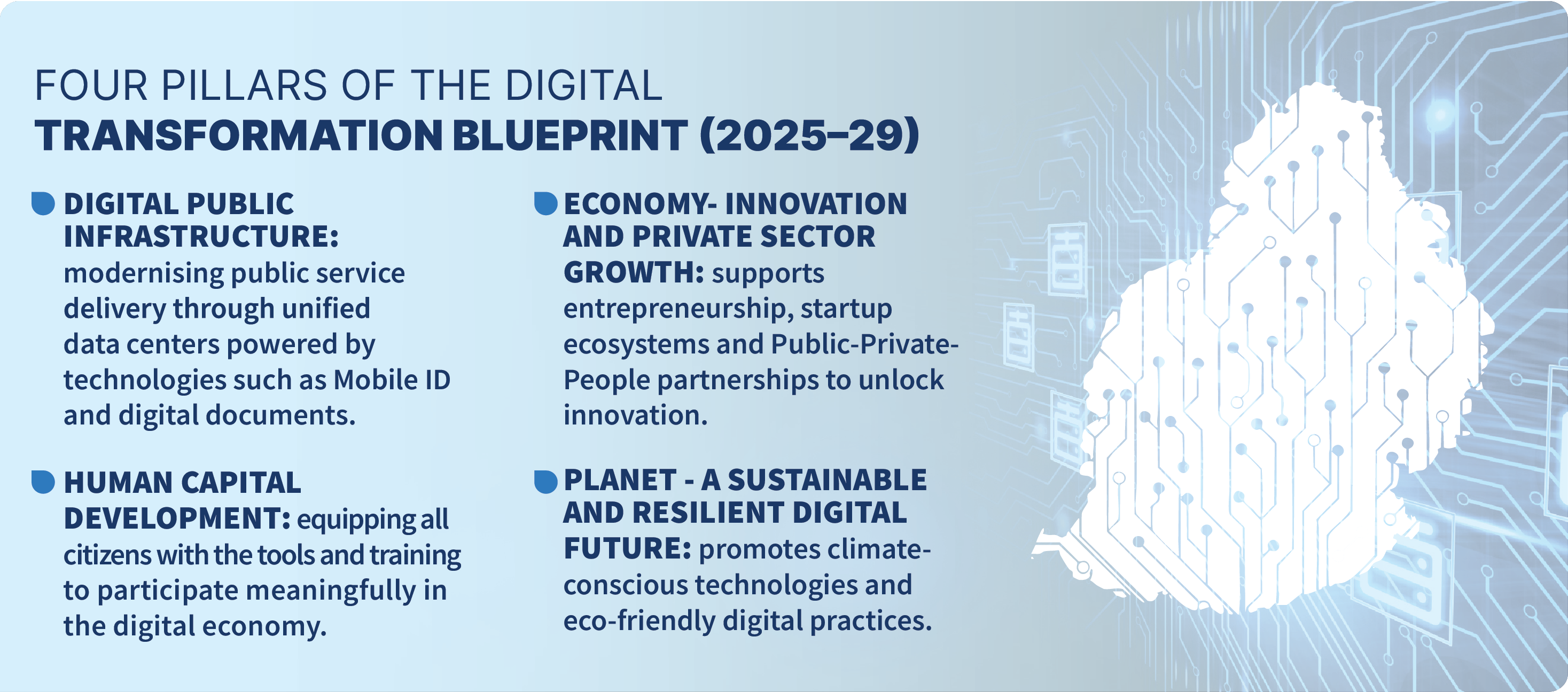
At the core of this ambition is the Government’s Digital Transformation Blueprint 2025–29, which sets out a comprehensive roadmap to modernise public services, strengthen trust in digital systems and foster innovation across the economy. The blueprint frames technology not as an end in itself, but as a tool to improve quality of life, competitiveness and inclusion, while preparing Mauritius for an AI-driven global economy.
Avinash Ramtohul, Minister of Information Technology, Communication and Innovation, underlines that progress in this field is evolutionary rather than instantaneous. “Digital transformation is more of a journey than a destination,” he says, reflecting Mauritius’ steady path from its first government data-processing initiatives in the late 1970s to today’s sophisticated digital ecosystem. ICT, he adds, is viewed as a key enabler of both economic progress and social well-being, with a clear ambition to export Mauritian digital services across Africa and into European and American markets.

The foundations for this ambition are already in place. Mauritius benefits from advanced digital infrastructure, including multiple submarine cables, near-universal fibre-to-the-home coverage and mobile penetration rates exceeding those of many developed economies. The country was also among the earliest in Africa to roll out 5G, thanks to a pragmatic spectrum policy that prioritises rapid deployment over costly auctions. This approach has allowed operators to focus investment on network quality, coverage and innovation.
Building on this connectivity, the government is now establishing a robust Digital Public Infrastructure that will underpin all future digital services. Unified digital identity, secure data-sharing platforms and interoperable government systems are designed to simplify interactions for citizens and businesses, reduce duplication and enable mobile-first access. A single government portal and planned “super app” will bring services together under one digital roof, reinforcing efficiency while improving user experience.
Strong governance and regulation are central to the credibility of Mauritius’ IT sector. The Information and Communication Technologies Authority (ICTA), established in 2001, has evolved into a proactive regulator overseeing telecoms, digital services, cybersecurity and emerging technologies. Its light-touch yet forward-looking regulatory stance has enabled innovation while maintaining high standards for service quality, competition and consumer protection. Legislative reforms are now aligning data protection with EU GDPR principles, updating electronic transactions laws to support blockchain-based trade, and modernising licensing frameworks to reflect converged digital services.

Cybersecurity and trust feature prominently in this strategy. Mauritius consistently ranks among Africa’s top countries for cybersecurity readiness, and new institutional reforms are strengthening resilience further. The establishment of a National Cyber Resilience and Cyber Security Agency, backed by mandatory audits and sector-specific standards, aims to protect critical infrastructure and sensitive data. At the same time, nationwide awareness campaigns recognise that cyber resilience depends as much on informed users as on secure systems.
Human capital development remains the sector’s most strategic investment. The government is prioritising digital literacy, AI awareness and advanced technical skills across all age groups, while addressing gender imbalances in STEM education. Initiatives such as gamified learning, AI integration in curricula and partnerships with international institutions are designed to ensure that Mauritians are not only users of technology, but creators and innovators within the digital economy.
The growing start-up ecosystem reflects this focus. Plans to consolidate incubators, investors and mentors within dedicated technology parks, alongside virtual laboratories and innovation sandboxes, are helping entrepreneurs test and scale ideas with global relevance. Public–private partnerships, described by the minister as “public–private–people partnerships”, are central to this approach, ensuring that innovation remains inclusive and locally anchored.
Strategically located between Africa and Asia, with political stability and ease of doing business, Mauritius is increasingly attractive to global technology firms seeking a secure regional base. Existing presences from major international players, combined with growing engagement with Gulf partners such as the UAE, point to expanding collaboration in areas ranging from smart governance to fintech and artificial intelligence.
As Mauritius accelerates its digital journey, its message to investors and partners is clear: the country offers not only advanced infrastructure and strong regulation, but a coherent, people-centred vision for technology-led growth. In doing so, it is redefining its IT sector as a trusted digital gateway between Africa and the wider world.


