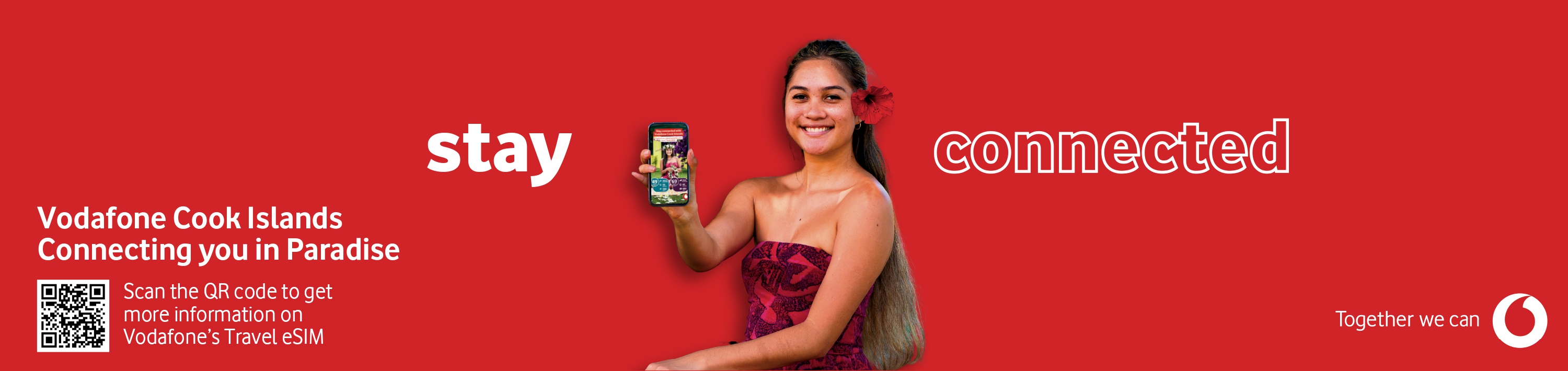
Few telecom operators face a challenge quite like the Cook Islands. Fifteen islands, around 17,000 residents, and roughly 772,000 square miles (2 million square kilometers) of ocean between them. For three decades, Vodafone Cook Islands has been the country's premier provider, delivering fixed-line, mobile, broadband, IPTV, and even postal services under a single government license, a true full-service operator in a market that, while competitive on paper, remains very small.
That breadth of coverage was no accident. It traces to an early-1990s government decision to grant the incumbent, then Telecom Cook Islands, an exclusive license carrying a mandate to connect every island under universal service obligations. In a tiny, remote market, that approach proved more effective than competition would have. The company maintained exclusive control over fixed, mobile, and international services until 2019 reforms, when the Telecommunications Act ended the monopoly and introduced an independent regulator, and it rebranded as Vodafone Cook Islands in January 2020. By the company's own account, the original universal-service model had already delivered, and competition has not significantly changed service levels, particularly in the remote outer islands.
Connectivity began with satellite in the mid-1990s and was transformed by undersea cable. In 2020 the Manatua One Polynesia cable reached Rarotonga and Aitutaki, linking the Cook Islands to Niue, Samoa, and Tahiti and dramatically expanding international bandwidth. The cable is owned and operated locally by Avaroa Cable Limited, a state-owned enterprise, with Vodafone as the anchor customer. Today every populated island has 4G mobile, broadband, and national TV and radio, with bandwidth the company says rivals Australia and New Zealand. Combined with both satellite and cable systems, that means citizens can participate fully in the digital economy, even where transport infrastructure is still catching up.
Now the operator is modernizing aggressively, rolling out fiber-to-the-home modeled on Australian and New Zealand systems, launching 5G, and running three purpose-built data centers for hosting and disaster recovery. Digital inclusion, in the company's view, means affordable access and letting people decide how to use it rather than forcing adoption. Notably, the Cook Islands is a well-banked nation, so some solutions like mobile payments haven't taken off as quickly as elsewhere, a reminder that moving too fast technologically can create its own challenges.
That infrastructure underpins tourism, the economy's engine. With just 17,000 residents but some 175,757 visitors a year, the network is built for a far larger scale: hotels connected by fiber, "hospitality-as-a-service" solutions, and travel SIMs and eSIMs that visitors activate before they ever land. The goal is to make connectivity seamless so guests can focus on enjoying the islands rather than hunting for a signal.
Reliability shapes the company's partnerships, too. As one of the smallest telcos in the world, it is highly selective, favoring partners who can scale solutions to its size and commit for 15 to 20 years over the latest startup innovation, however exciting. Cybersecurity follows the same disciplined logic: industry best practices, collaboration with regional and global telecom organizations, and secured data centers and cable systems, with the small nation's modest profile sometimes an advantage.
The guiding philosophy puts infrastructure ahead of everything else. The company sees artificial intelligence as a workforce multiplier rather than a threat, valuable for an economy facing workforce constraints, but only once the groundwork is laid. As its leadership frames it: "Connectivity comes first, without it, there's no AI or digital innovation."
Once that foundation is in place, the company believes, innovation can flourish and the whole economy grows more efficient. For now, the vision is high-speed, low-latency coverage across every island through a mix of fiber and satellite, a base on which everything else can be built.
For travelers, the advice is refreshingly simple. Arrive with an unlocked phone, and the rest takes care of itself: "We want you to enjoy your time here while staying effortlessly connected."
After thirty years of keeping a scattered nation online, Vodafone Cook Islands offers visitors a promise that matches, or exceeds, what they're used to at home.